

“How can you stay here [in Spain] for this long?,” Chris, a fellow American, asked during a break in our flamenco guitar session. I was teaching him some Bulerias–that fiery style of flamenco with an infectious groove that was born of the gypsies here in Jerez.
U.S. citizens can stay here (or in a lot of countries for that matter) for up to 90 days or less without needing any visa. You know… just in-and-out of the country to spend lots of money? Maybe. But what if you wanna stay for longer than that?
Applying for a long-term visa in Spain
Here below is the step-by-step process for applying for a non-lucrative visa which would allow you to stay in Spain for a year… to start with, with the possibility for yearly extensions later.
And why would you do that? Maybe you need a change. A lifestyle change? A sabbatical? Learn a new language? Wanna spend more time with the kids and the family and figure out what’s really important in your life? Why not?
After careful consideration, this non-lucrative visa was what I needed in order to make our family-gap-year-without-work happen quickly; that is, within 3 months of my wife agreeing to that serious family lifestyle change of quitting the jobs in the U.S. and move to Europe, two young kids in tow.
Our family gap year that started in the Sprng of 2017 has entered its third year. Now, the kids are on their 3rd year in public school for FREE! Imagine that!
So, how can I stay in Spain for a year, as a non-citizen of a European Union country?
The most straightforward way is to get a non-lucrative visa.
Sure, I could have flown to Spain and stay for 90 days. . . then fly back again into another EU country and work my way back into Spain. But that’s risky and complicated. I know of someone who did something like that but got rejected on the second entry within the same year. With my family in Spain, I could not risk that.
Or I could’ve found a Spanish wife and waited for a petition or a fiancee visa. But wait! I’m already married! Besides that would take a while, wouldn’t it? Not to mention the whole time and effort involved in finding and dating and charming and working your way into the heart of your future wife. That’s a lot work!
Else, I could have bought property or owned a business in Spain. Well, that requires time and money. I did not have either one at the time of our great exit to almost-full-time freedom. Now, I do have time (to be a house husband and do some the things that I’d like to do) but still don’t have money. Which one would you take?
Non-lucrative visa = no work
So the quickest way was to obtain a non-lucrative visa. It basically means that, if I do get it, I cannot officially work. The visa would grant me an extended stay (longer than 3 months) but not the permission to work.
When applying for a non-lucrative visa at the Spanish embassy/consulate here’s what I needed to do.
1-First. SHOW THEM THE MONEY!
. . . ok, not literally. But I needed to demonstrate to the Spanish government that I have enough money to support myself for a year without needing to work. This is the big one because it means, as in the words of Cuba Gooding Jr in Jerry Maguire, “show me the money!!!!” And I had just about enough of it for a year.
The good news is that it’s cheaper in southern Spain where my wife and I decided to have our year-without-work, especially if you choose to live in a smaller town or village instead of cities such as Madrid Barcelona, or even Seville and Malaga.
Still, it was rather difficult to pin down how much I needed for a month, for an entire year.
The embassy did not really give any clue as to what this magical number is.
Official online information was also vague at that time.
So, I guesstimated it using a cost-of-living online database and put in $1,500 per month ($18,000 for the year). I figured that if the average monthly net salary in Jerez was €1,100 (which was likely inflated in the first place) then I can put in this figure and add a little bit more. Well, it did the trick!
In reality, I had to prepare for the just-in-case scenario and have another $500 a month to cover the rest of the family. Afterall, we have two young kids and we’re walking into unfamiliar territory!
After the means-and-money requirement, the ones below were relatively easier to get.
2-Second: OBTAIN A MEDICAL CERTIFICATE
Since I was soon to lose my excellent medical insurance that goes with my job, I tackled this requirement next.
For this, you will just need to visit your doctor for a physical and mental health checkup and obtain your doctor’s official statement (on his/her stationary with his/her contact information) that you are both physically and mentally fit to travel to Spain.
Easy enough and I was up for a long-overdue physical checkup anyway. As you can imagine this could take you a half-day off from work.
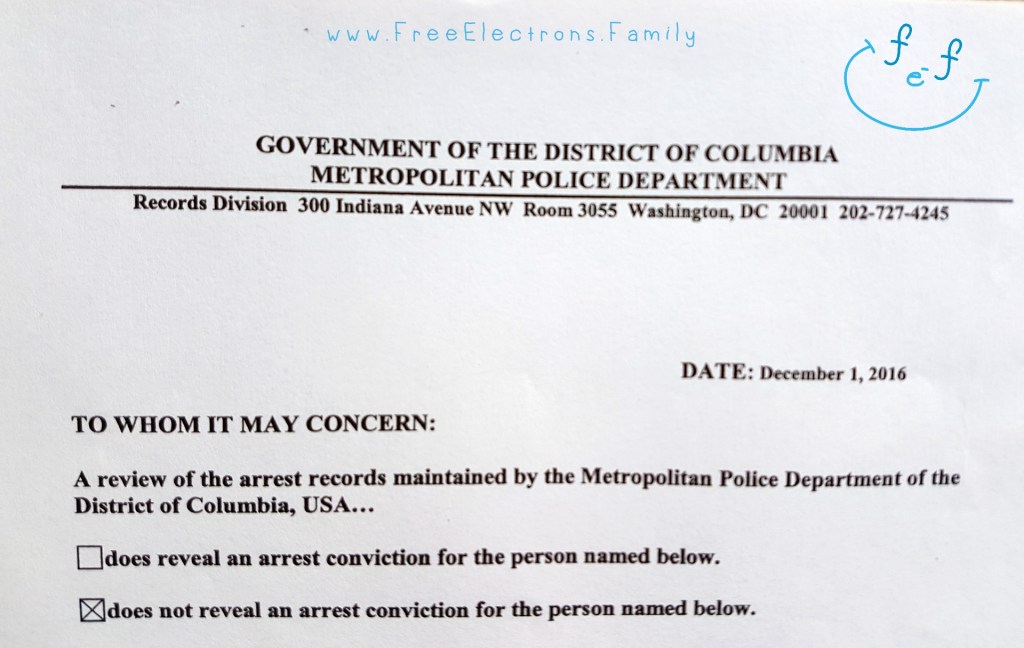
3-Third. GET A POLICE REPORT WITH AN HAGUE APOSTILLE CERTIFICATION
Naturally, a clean record would facilitate this and it would be a simple process of going through the following steps that may be similar to wherever you live.
In Washington DC, this is what I had to do. First, I went to the local metropolitan police department located in downtown DC and submitted a criminal history request for the visa purpose (FL-20). You just needed to go to the appropriate office and fill-in a PD 70 form with basic biographic information, including your Social Security Number.
After a bit of wait, you’ll get the oficial result–basically the PD 70 and the FL-20.
Then, I had to go to a different office to obtain the Hague Apostille. Get 2 copies, just in case. . . Heck you’re already there anyway.
It took about half a day from the queue to the final result. However, allow yourself a day, just in case.
You may be able to obtain the police report by mail depending on where you live.
4-Fourth. HAVE A PASSPORT
While writing the above, I assumed you already had a valid U.S. passport issued in the last 10 years and will not expire within six months. If not, then your first action should be: go get one or get one renewed.
5-Fifth. BUY HEALTH INSURANCE WITH COVERAGE IN SPAIN
There were several options out there. As I wrote about in part 2 of the questions that I needed to address in order to persuade my wife for us to quit the job and life in the U.S. and move to Spain, two young kids in tow, three summers ago.
I did not give it much cost-savings thought because I was in a hurry. I got one just for myself that satisfied the requirement for about $750 from Insubuy (Note: I receive no money, no nothing, NONE from this company or anyone else to mention this name).
I was able to purchase the insurance and, after a day or two of review process, received a letter of coverage that I needed to submit the application for a non-lucrative visa before the Spanish embassy’s work slowed down (if not closed) over Christmas holiday.
6-Sixth. Where will you stay in Spain?
As an option in support of your visa application, you may include information or lease agreement on where you will be staying in Spain.
If you do not have it, don’t sweat it. I did not have one until after I already applied for the visa.
7-Seventh. HAVE CASH FOR FEES
Have cash at least for a total of $151 (note this may be different now). The embassy stated that Money Orders were also accepted. . . But who still does that?!?
$140 was the visa fee for U.S. residents and $11 for a residency permit.
8-Eighth. SPANISH TRANSLATION
I needed to have the police report and medical certificate translated into Spanish, as part of the application.
I could have probably had a friend do the translation but I wanted to make sure that it would not be any problem.
So, I went with a certified translator online called Day Translations for extra expenses. (Note: I received no money, no nothing, NONE from this company or anyone else to mention this name). I just appreciate that it was a no-B.S. kind of service… and quick turnaround.
9-NINTH. make copies, submit and wait
And. . . That’s it. Submit and wait! Make sure you make copies of all the documemts that you will submit, just in case.
The embassy indicated that it would take a couple of months, given the holiday and all. And yet I received mine after 3 weeks!
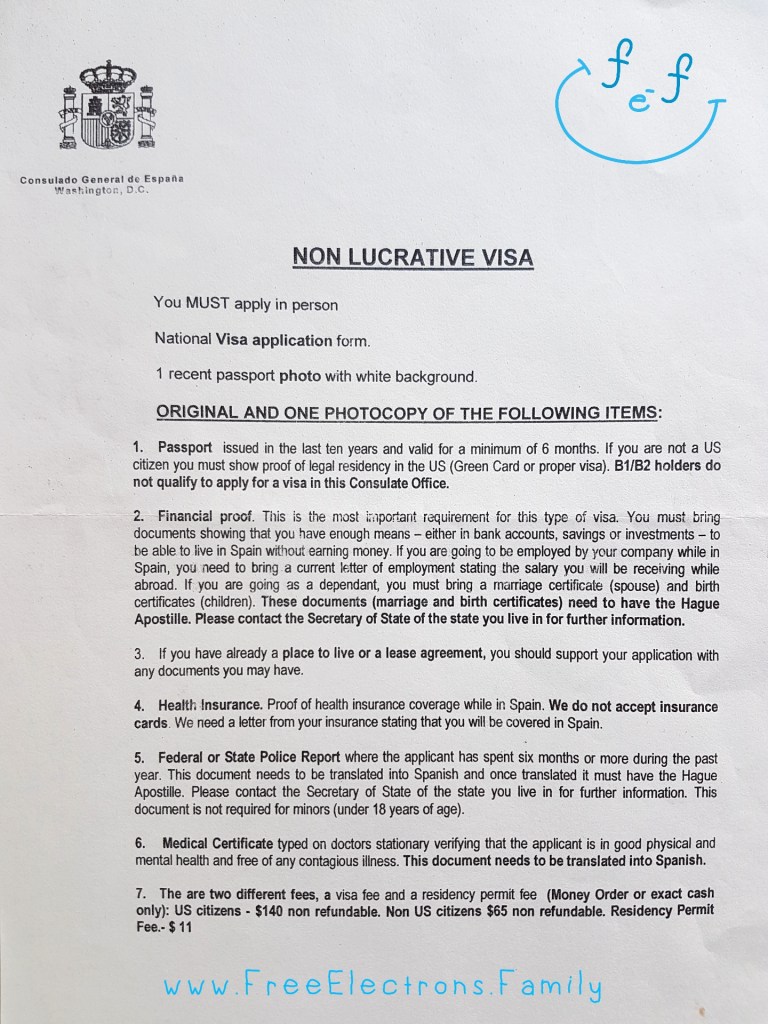
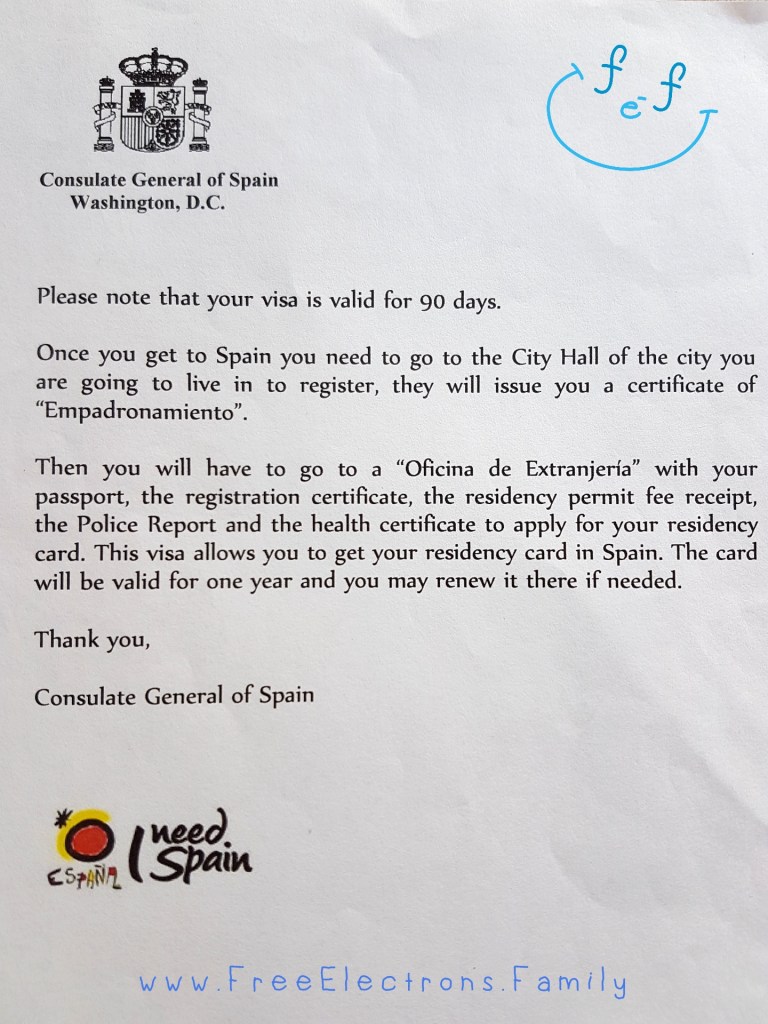
Make sure to check out the photos for more information from the Spanish embassy.
AND keep in mind that requirements could change from the time I submitted my visa application to when you do yours.
With my visa secured, I could move on to the seemingly ceaseless list of things of need-tos and honey-dos.
Here’s the quasi-glitch. Your stay is still dependent on the local autonomous region that you plan to stay in, such as Andalucia or Catalonia or Galicia.
There should be no worries though, as long as you don’t do anything illegal, criminal or falsify anything, you should be all right.
Let’s save that for the next post on this series of family move abroad: once in Spain, applying for your long-term residency within 90 days of arrival in Europe!
Happy travels. Have fun. Big Smile!
 free electrons family